




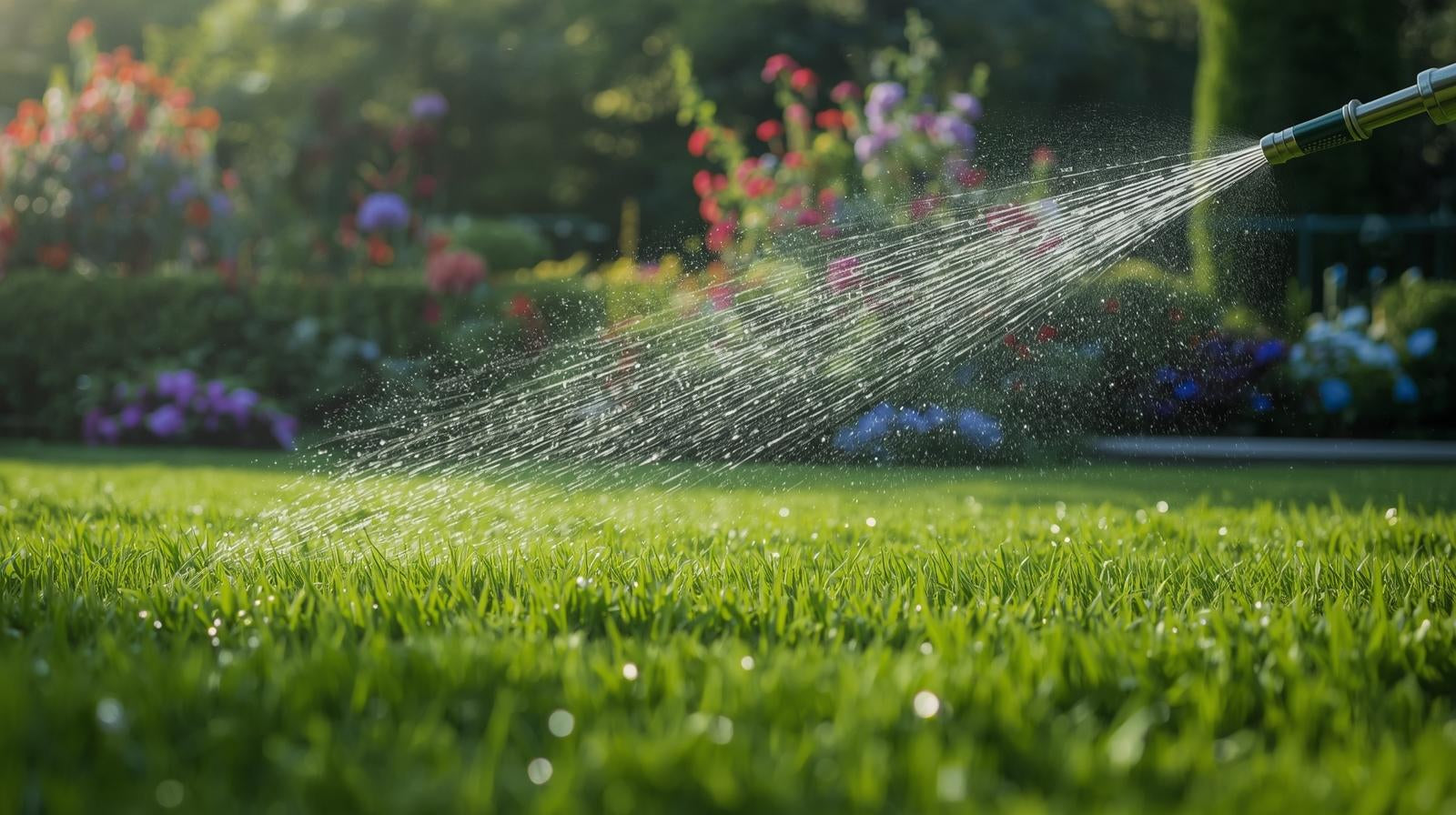
Anyone who just guesses or goes with their gut feeling will quickly end up with a lawn as patchy as Swiss cheese. As a robotic lawnmower expert from Segway Navimow, let me tell you: We Germans don't estimate, we measure! Watering for too long or too short a time wastes water, weakens the roots, and makes it harder for your robot to work. The watering duration isn't a guess, it's simple science. Only the precise duration ensures strong, deep roots.
So grab your stopwatch and tuna cans and get started on a lawn that truly deserves the name "carpet." In this article, I'll answer the most important questions: How much water does your lawn need, how long should you water, when is the best time, and how often should you water?
Contents
How much water does the lawn really need?
How long should you water your lawn and how much water does it actually need? Quite simply: it depends! Soil, weather, and grass type all play a role. But don't worry, I'll keep it short and sweet.
Factor 1: The soil
Germany and Austria have many soil types, ranging from sandy and loose to heavy and loamy. This determines how you should water your lawn correctly:
- Sandy soil: Water flows through quickly, so you should water more often – every 3 to 4 days, but preferably with less water (10 to 15 liters per square meter).
- Loamy/clayey soil: Retains water well, but too much can lead to waterlogging. It's better to water thoroughly every 5 to 7 days (15 to 20 liters), but slowly, so that the water soaks in well.
- Clay soil: A good mix that retains water and allows air to reach the roots. Watering once or twice a week is ideal here.
Pro tip:
- Do the spade test! After watering, dig out a piece of turf. The water should be at least 15 centimeters deep in the soil. If only the surface is moist, your efforts were unfortunately in vain.

Factor 2: The grass mixture
Many gardens in Germany and Austria typically feature a robust mixture of perennial ryegrass, Kentucky bluegrass, and red fescue. These grasses are easy to care for, but they have different requirements:
- Perennial ryegrass (Lolium perenne): Very resistant and fast growing, requires about 20 to 25 liters of water per square meter per week.
- Red fescue (Festuca rubra): Requires less water and nutrients, needs approximately 10 to 15 liters per square meter per week, particularly suitable for shady spots.
- Kentucky bluegrass (Poa pratensis): Forms dense carpets and tolerates heat well, requires about 15 to 20 liters of water per square meter per week, as well as regular nutrient supply.

Factor 3: Weather and season
The weather and the time of year also determine how much water your lawn needs for irrigation.
- Spring & Autumn: Often there is enough rain; additional watering is only necessary during long dry periods.
- Summer: The critical time! At temperatures above 25°C, 4-5 liters of water per square meter evaporate quickly every day. Observe your lawn closely: If the blades of grass no longer spring back when walked on and turn bluish-grey, it urgently needs water.
- Winter: During the cold season, the lawn rests. Normally, no additional watering is necessary, as rain or snow usually provides sufficient moisture.
Factor 4: The growth stage of the lawn
Depending on its stage of growth, your lawn needs different amounts of water. Especially during sensitive phases, the right amount is crucial for healthy growth and strong roots.
- Newly sown lawn: Now extra care is needed! The seeds must remain consistently moist – but not wet – for the first 3 to 4 weeks. On sunny days, you should water several times a day for 5 to 10 minutes, which corresponds to about 2 to 4 liters per square meter per day. Otherwise, the seedlings will dry out, and that's it.
- After fertilizing: Water thoroughly! You should apply 15 to 20 liters of water per square meter to flush the nutrients into the soil and make them available to the roots. This will also prevent unsightly scorching of the grass.
How long should you water your lawn?
These days, almost everyone uses a lawn sprinkler. But how long should it actually run? Instead of relying solely on your gut feeling, an app, or old wives' tales, there are more precise methods of measurement. Lawn irrigation isn't magic, it's simple physics.
How to measure correctly with the tuna can test
- You don't need expensive equipment, just at least six empty cans or cups with straight sides. Distribute these evenly across the lawn area covered by the sprinkler. Place some closer to the sprinkler and some further away.
- Because hardly any sprinkler distributes water truly evenly. Then turn on the tap and let the sprinkler run for a precisely defined time, for example, 30 minutes. Not a second more and not a second less.
- Take a ruler and measure the amount of water in each container. Write down the values; you'll be surprised how different they can be.
- Add up all the values and divide the sum by the number of containers. This will give you the average amount of water in millimeters that your sprinkler distributes in 30 minutes.
A real-world example:
Let's say you measure an average water depth of 8 millimeters after 30 minutes. To reach our target depth of approximately 16 millimeters, you need to double the running time. Your irrigation system should therefore run for 60 minutes to ensure the soil is sufficiently moistened. Knowing this puts you far ahead of your neighbor. You'll no longer be watering for "half an hour," but rather giving your lawn precisely the amount of water it needs for strong, deep root development.

Every sprinkler works differently!
This test is so important because not all sprinklers are the same. It makes a big difference whether you're using a slow-rotating gear-driven sprinkler or a fast spray sprinkler. Gear-driven sprinklers, which rotate slowly, often take the longest to achieve the required 15 to 20 millimeters of spray. Expect it to take 45 to 90 minutes. Spray sprinklers with a fixed spray pattern are often faster and can achieve the same amount in just 20 to 40 minutes. With the classic rectangular sprinkler, the water distribution is often uneven. The tuna can test is essential with this type to avoid dry spots or puddles.
When should I water the lawn?
Stop turning on your sprinkler on a whim or based on the weather forecast on your smartphone. Proper watering timing isn't a matter of intuition, but rather a sound strategy. Making mistakes here risks fungal growth or wastes water and money. Here's how to tell when your lawn really needs water.
The golden rule: The early bird catches the worm.
The best time is early morning, ideally between 4 and 8 a.m. Why so early? Quite simply:
- Minimal evaporation: The sun is still weak, the air is cool, and the wind is mostly calm. The water doesn't evaporate but reaches the roots directly.
- Disease prevention: The lawn can dry out during the day. Wet grass overnight invites fungal diseases such as red thread or snow mold. Watering in the evening is therefore risky.
Watering at midday in the heat is pointless; the water evaporates almost completely before it reaches the roots. This is a waste of water and money. Late afternoon, between 4 and 6 pm, is only a last resort if there's no time in the morning. However, this increases the risk of fungal infections.
Special rule 1: After the cut comes the rest period.
A freshly mowed lawn is stressed. Every blade of grass has cuts. If you water immediately afterward, you'll wash pathogens into these open wounds. It's like putting salt on your face after shaving. Wait at least a day between mowing and watering to allow the grass to recover.
Special rule 2: Listen to the weatherman – but do it right.
When it's windy, keep the tap off. Otherwise, the wind will scatter the water droplets, your lawn won't get enough water, and your neighbor will be happy. That's inefficient and inconsiderate.
Special Rule 3: The law is tougher than your thirsty lawn
Check your city or town's website for water restrictions. Especially in summer, there are often rules about when you're allowed to water. Ignoring these rules can result in fines that cost more than laying new turf.

How often do I need to water the lawn?
The most important rule is: water less frequently, but deeply. Watering briefly every day pampers the blades of grass, but the roots remain weak. Watering thoroughly once or twice a week ensures strong, deep roots. A guideline is about 10 to 20 liters of water per square meter per week. In hot, dry weather, you can water two or three times. This will keep your lawn dense and lush green instead of brown and dry.
Forget the calendar and trust your eyes and a spade. For a typical garden with clay-sand soil, this means in summer:
- Water thoroughly once or twice a week.
- Observe your lawn closely.
- When it turns bluish-grey or the stalks no longer stand up when stepped on, it's time to water – regardless of what the calendar says.
A wise gardener observes, a lazy one rigidly follows a schedule. And your robotic lawnmower immediately notices whether the lawn is deep and resilient or pampered and weak. If you're already so precise with watering, your mower shouldn't be any less so: A device like the Segway Navimow i105 works without a bothersome boundary wire and mows so precisely that it, too, creates the best conditions for a truly lush, carpet-like lawn. Perfection in lawn care demands perfection in technology – and that saves time, which you can then use for the tuna can test.

Conclusion
To put it simply: If you love your lawn, stop guessing and start measuring precisely. Watering depends on the soil, grass type, and weather. The important thing is to water less frequently but deeply, about 15 to 20 liters per square meter, to ensure strong roots.
Use the tuna can test to determine the correct watering duration. Ideally, water early in the morning and ensure the soil is moistened to a depth of at least 15 centimeters. This will give your lawn the boost it deserves, and so do your neighbors.
And speaking of stress-free perfection: A modern robotic lawnmower like the Segway Navimow i-Series, with its wireless (no boundary wire!) and precise navigation, ensures that this perfectly irrigated lawn is also cut flawlessly. No more complaining, just results. Get started!
FAQs: More questions about watering the lawn
Can I water my lawn at night?
Watering at night is not recommended. The moisture remains overnight and promotes fungal diseases.
When should I water the lawn after fertilizing?
Wait one to two days after fertilizing before watering. However, always follow the fertilizer manufacturer's instructions, as some fertilizers require immediate watering.
How do I prevent waterlogging when watering?
For heavy soils, the "cycle and soak" method is recommended: Instead of watering for a long time at a time, divide the watering into several short cycles with breaks in between. This allows the water to soak in better and prevents it from running off.
What mistakes should you avoid when watering your lawn?
Avoid watering at the wrong time of day (e.g., midday or evening), watering for too short or too long periods without measuring, and ignoring the soil type. Proper timing and adjusting the amount of water are crucial for a healthy, deep-rooted lawn.


Share